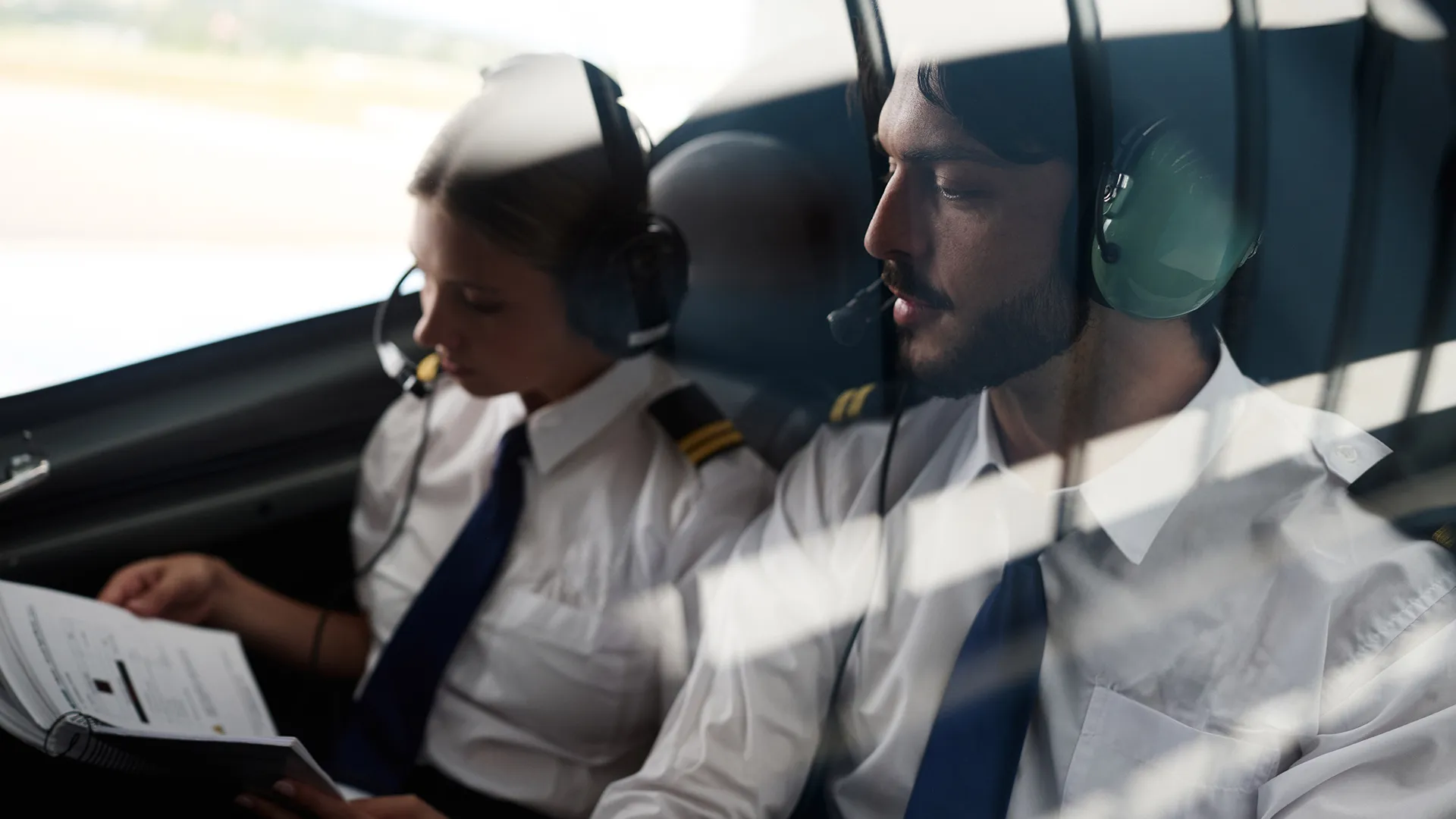
A Commercial Pilot Licence (CPL) in India is an official professional aviation certification issued by the Directorate General of Civil Aviation (DGCA) that legally allows a pilot to fly aircraft and receive payment or hire for their services. It is issued under the Aircraft Rules, 1937.
DGCA also issues an Airline Transport Pilot Licence (ATPL), which is associated with command of scheduled airline operations.
Who should consider becoming a commercial pilot?
Commercial pilot training suits candidates who have completed 10+2 with Physics and Mathematics or equivalent, who can establish medical fitness to DGCA's satisfaction, and whose families understand the financial commitment involved in completing the necessary ground training and 200 hours of flight training.
What are the DGCA requirements to become a CPL?
The Directorate General of Civil Aviation prescribes the age, educational, medical, knowledge and flying experience requirements to become a Commercial Pilot Licence (Aeroplane) in the Aircraft Rules, 1937 and Civil Aviation Requirements. Total flight time is never the only condition, because DGCA also prescribes pilot-in-command, cross-country, instrument and night flying etc.,
What are the eligibility requirements to start CPL training in India?
To register as a Flight Crew candidate, applicants other than PPL candidates must have passed 10+2 with Physics and Mathematics from a recognised board, or equivalent. The DGCA Pariksha portal states the minimum registration age is 16 years, with no maximum age limit.
Medical fitness is assessed by DGCA-approved medical examiners against DGCA standards.
What documents do you need for DGCA Pariksha registration?
DGCA Pariksha allots a Computer Number, the unique identification number that tracks a candidate through DGCA examinations. A candidate may hold only one, and its validity is stated as lifetime. Assemble all of these documents first, because incomplete uploads delay registration.
- Board Certificates, mandatory for new candidates
- Class 10 and Class 12 marksheets with pass certificates
- Association of Indian Universities equivalency certificate, if applicable
- Photograph and signature to portal specification
What are the steps to become a commercial pilot in India?
Two DGCA portals are involved. DGCA Pariksha handles examinations. The eGCA portal handles licensing, and Flight Crew Licensing Circular 01 of 2024 states applicants must register online at eGCA for a unique eGCA ID. Registering for one does not register you for the other.
- Confirm current educational and age conditions with DGCA.
- Complete the medical assessment before committing funds.
- Register on DGCA Pariksha for your Computer Number.
- Register on eGCA for your eGCA ID.
- Complete DGCA ground classes or equivalent.
- Pass the prescribed DGCA theory papers.
- Obtain a Student Pilot's Licence as DGCA prescribes.
- Train with a DGCA-approved Flying Training Organisation.
- Complete RTR(A) preparation
- Add an Instrument Rating and Multi-Engine Rating.
- Pass the skill test, then apply through eGCA.
Which DGCA exams do you need, and what are RTR(A) and FRTOL?
DGCA conducts Flight Crew Licence examinations through DGCA Pariksha, covering air navigation, aviation meteorology, air regulations and technical subjects. The Directorate General of Civil Aviation now fully regulates and conducts the Radio Telephone Operator Restricted (Aeronautical), RTR(A), examination, replacing the earlier Wireless Planning and Coordination arrangement.
DGCA also approves English Language Proficiency test providers. Confirm whether ELP applies to you.
How does ARCA Aviation structure its commercial pilot training?
ARCA Aviation is a DGCA-approved Flying Training Organisation at Begumpet Airport (VOHY), Hyderabad, an aerodrome with active air traffic control. ARCA's CPL programme is structured as 185 hours single-engine and 15 hours multi-engine flying, within the 200 hours DGCA prescribes.
| DGCA requirement | ARCA's programme | |
|---|---|---|
| Flying experience | Minimum flight time, and its prescribed composition | 185 hours single-engine, 15 multi-engine |
| Licence issue | DGCA decides and issues | ARCA trains, issues no licence |
Training commenced on 14 March 2026. The launch fleet comprised two Tecnam P2010 TDI aircraft and one Tecnam P2006T twin. See ARCA's training fleet, ARCA's Commercial Pilot Licence programme and commercial pilot training in Hyderabad.
How long does it take to become a commercial pilot in India?
There is no fixed duration, and any organisation quoting a guaranteed completion date is quoting something that it cannot control. Training time depends on weather, aircraft serviceability, air traffic control constraints, instructor availability, student progress, examination cycles and medical processing.
What does commercial pilot training cost in India?
Commercial pilot training in India is a major financial commitment, and the total is not a single number. It covers flight training, ground training, simulator time, multi-engine flying, DGCA examination fees, medical assessment and living costs, with several items billed separately.
What should you ask a flying training organisation before you pay?
Before paying anything, ask for written answers on regulatory status, fleet, maintenance, instructor availability and the full cost structure. A DGCA-approved organisation should answer all of these without hesitation, and vague answers at the enquiry stage become expensive problems later.
- What is your current DGCA approval status and approved scope of training?
- What aircraft are on your fleet, and what is billed separately from the fee?
Does a Commercial Pilot Licence guarantee an airline job?
No. A Commercial Pilot Licence is a professional licence, not an airline job. Airline employment depends on the airline's own recruitment criteria, its licence rating and type rating requirements, medical fitness, experience and its selection process. No training organisation can guarantee employment.
Common mistakes to avoid
- Choosing on advertised price alone. The headline price may not be the final cost.
- Delaying the medical assessment. Establish suitability before committing large sums.
- Confusing Pariksha with eGCA. One handles examinations, the other licensing.
- Treating 200 hours as the whole requirement. DGCA prescribes how they are composed.
- Assuming an hour split is a DGCA rule. DGCA sets the 200-hour minimum. How an organisation divides those hours between single-engine and multi-engine aircraft is its own decision.
Frequently asked questions
What qualification do you need to become a commercial pilot in India?
Applicants other than PPL candidates must have passed 10+2 with Physics and Mathematics from a recognised board, or equivalent, to register for DGCA Flight Crew examinations. International qualifications need an Association of Indian Universities equivalence certificate.
Is there an age limit to become a commercial pilot in India?
DGCA Pariksha states the minimum registration age is 16 years, with no maximum age limit. The absence of a maximum age does not mean age has no practical impact. A person starting later has a shorter remaining career span in which to obtain employment and recover the substantial cost of training, so consider age, medical fitness, expected career duration and return on investment before committing.
How many flying hours are required for a CPL in India?
The minimum flight time for a Commercial Pilot Licence (Aeroplane), and how it must be composed across pilot-in-command, cross-country, instrument and night flying, is prescribed by DGCA. Confirm the current figures against the Aircraft Rules, 1937.
Do you need a medical certificate to become a commercial pilot?
Yes. Medical fitness is a condition of licensing, assessed by DGCA-approved medical examiners against DGCA standards, and the class required at each stage is prescribed by DGCA. Arrange it before committing significant funds.
What is the difference between DGCA Pariksha and eGCA?
DGCA Pariksha is the examination portal, where a candidate obtains a Computer Number and applies for examinations. eGCA is DGCA's licensing portal, where an applicant registers for a unique eGCA ID. Registering on one does not register you on the other.
Is RTR(A) the same as FRTOL?
DGCA now fully regulates and conducts the Radio Telephone Operator Restricted (Aeronautical) examination, replacing the earlier Wireless Planning and Coordination arrangement. The governing Rules, 2025 were notified by S.O. 710(E) and S.O. 711(E) dated 10 February 2026. DGCA separately issues the FRTOL.
Official regulatory sources
- Directorate General of Civil Aviation. Aircraft Rules, 1937, CARs, Flight Crew Licensing circulars.
- DGCA Pariksha. Registration, Computer Number, examinations, results.
- eGCA. eGCA ID registration and licensing services.
- Department of Telecommunications, WPC Wing. RTR(A) and the RTR Rules, 2025.
Next regulatory review: On any relevant DGCA regulatory change, or at least every 3 months.
Technical review: ARCA Aviation Training Department
Regulatory requirements can change. This page is for general guidance. Candidates must verify current requirements with DGCA and with ARCA's admissions team before making financial or training commitments.